Build · Directories
The Directory Factory That Never Stamps the Same Site Twice
The directory factory turns a short interview into a new directory in any industry. Each one is built with its own data model, URL layout, fonts and page shape, so a network of sites does not share one footprint.
- Year 1Website
- Year 2Map Listings
- Year 3Booking Tool
- Year 4Front Desk
- Year 5Payments
- Year 6Reports
Same six pieces.
Built once. Switched on in hours.
The Short Version
- A short interview settles the four choices that shape a directory.
- Each site gets a different data model, URL layout, fonts and layout from the one before.
- Every page says something from its own record that no other page could say.
- A footprint check compares the built site with its siblings before it ships.
| Start | Short interview |
|---|---|
| Per site | Own data model and URL layout |
| Design | Own fonts, layout and class names |
| Content rule | Each page from its own record |
| Gate | Footprint check on built output |
| Hosting | Static files at the edge |
- InterviewTradeKeywordsProductsGeography
- MapWhat a page isHow many sides
- Site DNAURL layoutFontsLayoutClass names
- Data and proofMatch by idNo invented reviews
- ShipFootprint checkPaste testLaunch list
Why Copying the Last Site Costs You
The fastest way to build a second directory is to copy the first one and change the words. It saves a few days. Then you do it again, and again. Before long you have a set of sites with the same paths, the same page skeleton, the same class names and the same sentences.
Anyone comparing two of them can tell in a minute that they are one operation. So can a search engine. And if the pages are thin, with one sentence and a city swapped in, that is the kind of site that draws a penalty.
Those are two separate risks. A shared footprint ties the sites together. Thin pages get them judged. Changing the colors fixes neither one.
What We Built
The factory runs in five steps, and nothing is written until the third one is done.
- The interview. One short block of questions about the trade, the keywords, the products and the area. Short answers are enough. We say what we inferred and move on.
- The map. This is the choice that matters most. What is a page, and how many sides are there? A repair shop directory has one side. The shop is the page and the driver never signs in. A rental site might have two, a rig and a campground, an owner and a renter. Those want different databases and different navigation.
- The DNA. A script rolls the site's own traits from its name. URL layout, fonts, layout, card shape, class names. It checks every roll against the sites already in the network that share a trade or a city, and rerolls any match.
- Data and proof. Records are matched by id, never by name. Duplicates collapse on phone. Nothing is invented. A placeholder fact blocks launch.
- Build and ship. A fresh generator for this site, checks that fail loudly, and a launch list.
How It Is Wired
The DNA roll is the same every time for the same site name. That matters. A rebuild six months from now must produce the same site, not a new one. Pure chance would also collide constantly. With a small set of palettes and many sites, two sites in one trade would land on the same look.
After the build, two tests run on the output, not the source. The source is where you think the sites differ. The output is where they really do or do not.
- The paste test. Take the opening lines from a few listing pages and paste each under a different record. If it still reads true, the copy is a template and the data step is not done.
- The footprint test. Compare the built site with every sibling in the same trade. It fails on shared paths, shared class names, a shared title formula, a shared skeleton, shared sentences, or a shared phone number or analytics id.
The static output is hosted the way we describe on the static site builds page.
What Broke and What We Changed
Our Own Sites Failed the Test
When we first ran the footprint check across our own network, it failed. Several older directories shared the same set of paths and much of the same class vocabulary, because each build script was an edit of the last one. Some even shared a phone number. That is the reason the factory forbids starting from a copied folder.
Invented Facts Slipped In
A directory with no reviews is tempted to fill the gap. Made up ratings and dummy phone numbers had crept onto some sites. The factory now marks every placeholder, and a placeholder blocks launch.
Lead Forms That Went Nowhere
A lead form is the reason most directories exist. We found forms across the network that had never captured a single submission, and endpoints posting into a dead address. Now every site proves its form with one real test submission before launch, then deletes the test row.
What the Factory Deliberately Does Not Do
- It does not copy a site folder. If asked to, it says what the copy costs in one sentence.
- It does not build a CRM inside a directory. A lead or a claim goes out as one clean record with a key to dedupe on. What happens next belongs to the desk.
- It does not invent a review, a rating or a count. Ever.
Each limit adds a little time to a build. Together they are the product.
What It Means When You Switch It On
You get a directory in your industry that looks and reads like its own site, because it is. Its pages say something true about each record. Its structure does not match anything else we run. And its lead form has been proven before a visitor ever sees it.
You skip the months of deciding what a directory should be. The interview takes a few minutes. The build follows from the answers.
For the full method, read the guide to a directory without a template.
Questions People Ask
Can you build a directory for my industry?
Yes. A short interview about your trade, keywords, products and area sets the shape, and the site is built from those answers.
Will my directory look like your other sites?
No. Each site gets its own data model, URL layout, fonts and layout, and a footprint check compares it with its siblings before it ships.
Where do leads from the directory go?
Each lead goes out as one clean record to the place you choose. The directory does not try to be your CRM.
Will the listings have fake reviews to look full?
Never. A missing review stays missing, and any placeholder blocks the launch.
Keep Going
Free guideDirectory GuideBuild a Directory Site That Does Not Look Stamped From a Template
A directory is four decisions and a lot of typing. Make the decisions first, give every page something only its own record could say, and never start by copying the last site.
Read it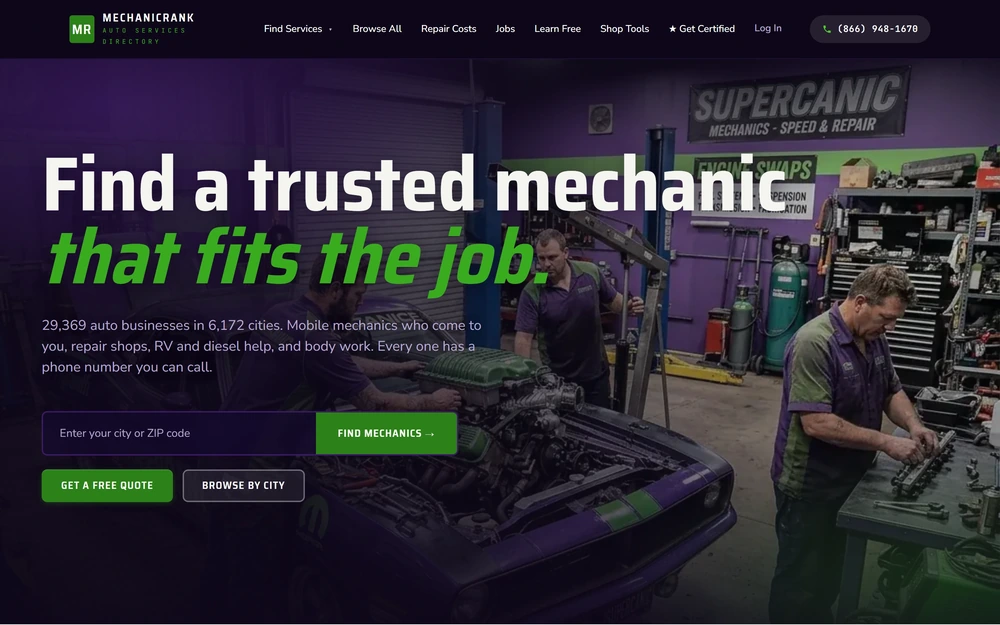 Build · Directory
MechanicRank, a Repair Shop Directory Built Like a Pipeline
MechanicRank is a directory where drivers find repair shops. It is a static site built from a staged data pipeline, and a gate at the end refuses to publish if any stage came back short.
Read it Build Layer
Static Site Builds With Plain Python
Every site we run is written by one Python script that uses only the standard library and outputs plain HTML. A checker reads every page after each build and stops a broken link before a customer finds it.
Read it Avenue 1 of 8
Getting Found by the People Already Searching
People near you are searching for what you do right now. We switch on the site, the profile, the city pages and the indexing that put you in front of them, in hours instead of months.
Read itWe sell time
Get Years of Building Switched On in Hours
A thirty minute call. A written price. Nothing built until you say yes.