Texting Guide
A2P 10DLC Registration for a Small Business
If your business sends texts from a normal ten digit number through any software, you have to register for A2P 10DLC or the carriers filter you and charge extra. Register the brand, then the campaign, and make your website, samples and opt-in box match before you file, because a mismatch is what gets you rejected.
- Year 1Website
- Year 2Map Listings
- Year 3Booking Tool
- Year 4Front Desk
- Year 5Payments
- Year 6Reports
Same six pieces.
Years of lessons, one read.
Free to read. Most of this guide is open. The finishing pieces at the end come to you when you opt in.
Start Here
- Anyone texting US phones from software on a ten digit number must register. That includes one person shops.
- It is two steps. The brand is who you are. The campaign is what you send and how people said yes.
- Expect a one time fee in the tens of dollars, a small monthly fee, and about a week of review.
- Most rejections are mismatches. The legal name, the website, the samples and the opt-in box have to agree.
- Your opt-in box must start unchecked, must be optional, and must say how often you text and how to stop.
What A2P 10DLC Is and Who Has to Register
A2P means application to person. It is any text that a piece of software sends for you. A missed call text back, a quote link, an appointment reminder and a review request are all A2P. 10DLC means a normal ten digit long code, the kind of local number your customers already know.
The big US carriers want to know who is behind every one of those texts. So they set up a registry, and every business that sends them has to sign up. Twilio's docs, last updated July 7, 2026, say plainly that anyone sending texts from an application over a 10DLC number to the US must register, and that includes single people and hobbyists. Toll free numbers and short codes run on their own separate checks, so this guide does not cover them.
We set up texting for every front desk we run. Each business gets its own registration, built from facts the owner gives us, not from guesses. The steps below are the ones we follow every time.
Skipping it has a cost. Twilio says unregistered traffic pays extra carrier fees, and that registered traffic gets less filtering and more throughput. In plain words, your texts cost more and fewer of them arrive. A customer who never gets the quote link does not call back to ask where it went.
The Two Steps, Brand Then Campaign
Registration has two layers. You do them in order.
The brand is your business. You give your legal name, your EIN, your address, your website and a contact person. The registry checks them against public records. If the name you type is not the name on your IRS letter, it fails here.
The campaign is what you will send. You pick a use case, like customer care or marketing, write a description, give sample texts, and show how people agree to get them. A person at the carrier side reads this part. They look at your website and your opt-in form to see that it all lines up.
You can have more than one campaign under one brand. A shop that sends both appointment reminders and promo texts can file them together as a mixed campaign, or apart. Keep it simple at first. One campaign that matches what you really send beats three that look padded.
Pick the Right Brand Type
Twilio lists three brand types, and the daily limits differ a lot.
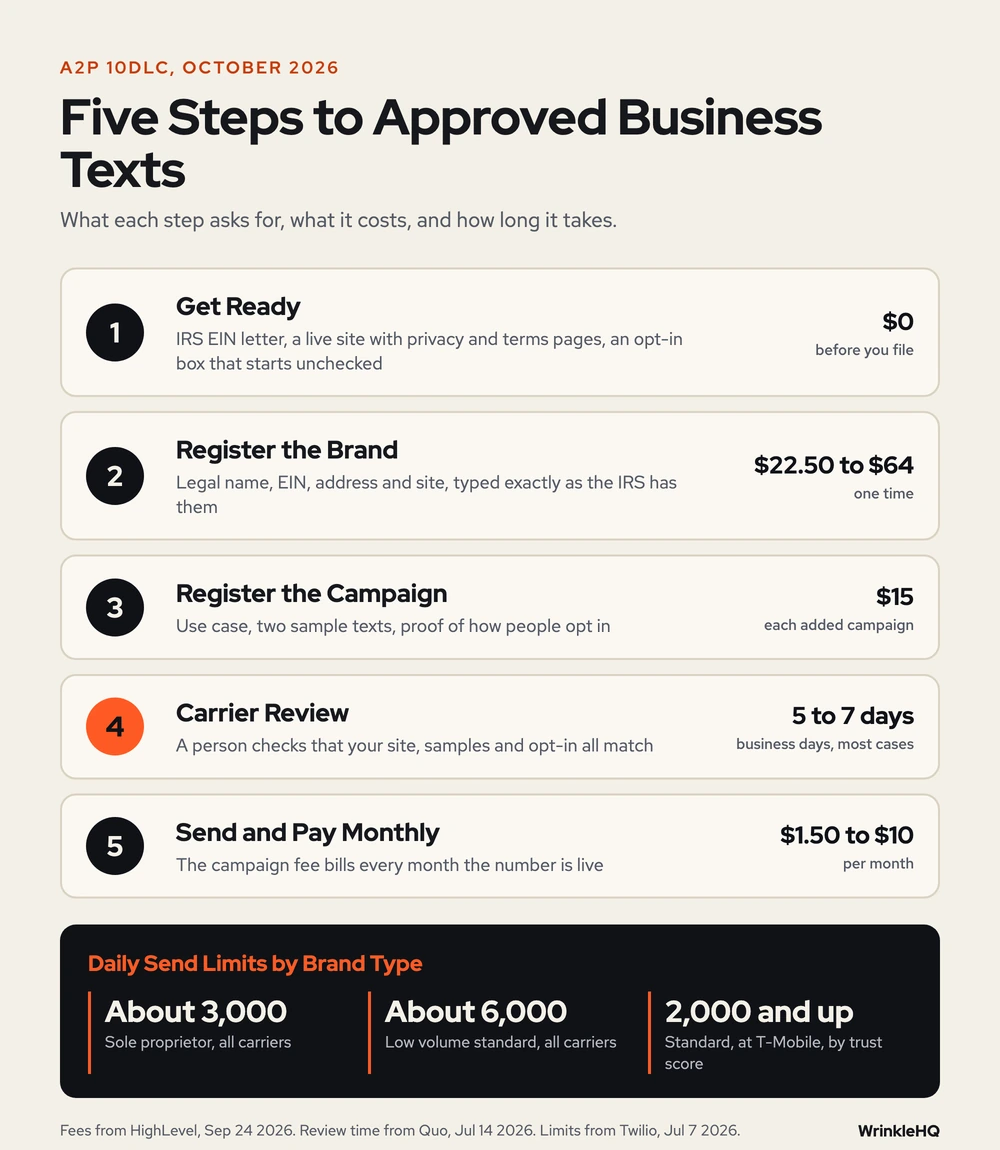
| Brand type | Who it fits | About how many texts a day |
|---|---|---|
| Sole proprietor | No EIN, one person, one campaign | About 3,000 across all carriers |
| Low volume standard | Has an EIN, sends a modest amount | About 6,000 across all carriers |
| Standard | Has an EIN and sends at volume | 2,000 and up at T-Mobile, set by trust score |
Those limits come from Twilio's docs dated July 7, 2026. Low volume standard is the right fit for almost every local service business. A shop that sends a few hundred texts a day is nowhere near the cap. If you have an EIN, do not file as a sole proprietor to save a few dollars. A business name on a sole proprietor brand is its own rejection reason.
What It Costs and How Long It Takes
Fees pass through from the carriers and the registry, so they look much the same everywhere. HighLevel lists these in its fee article, last changed September 24, 2026.
| Fee | Amount | How often |
|---|---|---|
| Brand, sole proprietor or low volume standard | $22.50 | One time |
| Brand, high volume standard | $64 | One time |
| Vetting for each added campaign | $15 | Per campaign |
| Low volume mixed campaign | $1.50 | Monthly |
| Sole proprietor campaign | $2 | Monthly |
| Standard campaign | $10 | Monthly |
Other tools package it a little differently. Quo's guide, dated July 14, 2026, lists a $19.50 one time fee, $1.50 a month on the EIN path, $2 a month for sole proprietors, and $15 to resubmit after a rejection. HighLevel says it adds no markup and does not charge again to resubmit a rejected campaign. Either way, plan on less than $100 to get started and a few dollars a month after.
Time is the bigger cost. Quo says the form takes about 10 to 15 minutes, and most businesses are approved in 5 to 7 business days, with some taking 7 to 10 days or more. Every rejection starts that clock again. That is why the next section matters more than the form itself.
Fix These Before You File
The reviewer checks one thing above all: does everything match? Fix these four things first and most of the risk is gone.
- Your legal name and EIN match the IRS exactly. Pull your EIN letter and copy the name letter for letter, with the same Inc or LLC. If you trade under another name, add it as your DBA. HighLevel's rejection list says a run of failed tries usually means the business details do not match the IRS record.
- Your website is live and looks like your business. It needs your business name, what you do, a way to reach you, a privacy policy and terms. A page that is only a form, a page behind a login, or a site that says coming soon all get rejected.
- Your privacy policy says you do not share phone numbers for marketing. One of HighLevel's listed rejection codes is a privacy policy that lets you share opt-in data with third parties for marketing. Say clearly that mobile information is not shared with third parties or affiliates for marketing.
- Your contact email is on your own domain. A free webmail address for the brand contact is its own rejection code. Use an address at your business domain.
Then build the opt-in. HighLevel's best practices say a phone number on a form is not, by itself, consent to get texts. You need a separate checkbox for texts. It must start unchecked. The form must still send if the box is left empty. Next to the box, say who is texting, what kind of texts, how often, that message and data rates may apply, and how to get help or stop. Link the privacy policy and terms right there.
Write the sample texts last. Use your real business name in every one. Match the use case you picked. Put opt out words like Reply STOP to opt out in at least one. Use brackets for anything that changes, like [First Name]. Use full https links, never a link shortener. Make each sample different. Copied text across fields is its own rejection code too.
Once those are in place, file the brand, wait for it to pass, and then file the campaign. Our guide to missed call text back shows the first texts most businesses should send once approved.
Look It Up Yourself
All sources accessed October 2026.
- Twilio, Programmable Messaging and A2P 10DLC, docs page last updated July 7, 2026. Who must register, brand types, daily limits, extra fees for unregistered traffic.
- HighLevel, A2P 10DLC Messaging Fees, help article modified September 24, 2026. Brand, vetting and monthly fees.
- HighLevel, A2P 10DLC Campaign Approval Best Practices and A2P Campaign Rejections, Required Fixes and Vetting Errors. Opt-in rules, sample rules, rejection codes.
- Quo, What Is A2P 10DLC and How to Get Registered in 2026, July 14, 2026. Form time, review time, Quo's own fees.
What the Finishing Pieces Contain
You can register and pass from what is above. The finishing pieces give you the opt-in box wording, the privacy policy paragraph, and the campaign description in a fill in the blanks form. They also give you the rejection codes that trip up local businesses, what each means and the fix. They end with the check we run before we press submit. To see how texting fits the rest of the front desk, read about the CRM and phone stack.
The finishing pieces
Get the Rest of This Guide
You have the method. The finishing pieces are the parts you copy straight into your own work:
- Copy Ready Opt-In and Privacy Wording
- Campaign Description and Sample Texts
- Rejection Codes and the Fix
- The Check We Run Before We Press Submit
Odds and Ends
- Do I really need A2P 10DLC registration for a small business?
- Yes, if you send texts from software over a normal ten digit number. Twilio says it covers anyone texting US phones that way, even single people. Without it, texts cost more and more of them get filtered.
- How long does A2P 10DLC registration take?
- The form takes about 10 to 15 minutes. Quo says most businesses are approved in 5 to 7 business days, and some take 7 to 10 days or more. A rejection starts the wait again.
- How much does it cost to register for A2P 10DLC?
- HighLevel lists $22.50 one time for a low volume or sole proprietor brand, $64 for high volume, and monthly campaign fees from $1.50 to $10. Most small businesses start for under $100.
- Why was my A2P campaign rejected?
- Most often something does not match. The legal name differs from the IRS letter, the website lacks a privacy policy, the opt-in box is prechecked, or the samples do not name the business. Fix every listed reason before you resubmit.
- Can I register without an EIN?
- Yes, as a sole proprietor. You get one campaign and about 3,000 texts a day across carriers. If your business has an EIN, use it, because a company name on a sole proprietor brand gets rejected.
Other Answers
 Free guideAnswering Guide
Build a Missed Call Textback That Does Not Embarrass the Business
A missed call textback should know who called before it picks its words, and it should never say something the business would not say. This guide shows you how to build one that holds up when nobody is watching.
Read itContact LayerCRM and Phone With GoHighLevel and CallRail
Every form, call and text lands in one GoHighLevel inbox as a contact with tags that say where it came from. CallRail tells you which page or ad made the phone ring.
Read it Avenue 2 of 8
Answering Every Call, Even the Ones You Miss
When you cannot pick up, the customer gets a text back in seconds and a way to tell you what they need. When the question needs a person, it goes to a person.
Read it Free guideReviews Guide
Automate Review Requests Without Breaking Platform Rules
Ask every customer, right after the job, with one reminder and nothing in return. Then reply to every review you get, good or bad.
Read itWe sell time
Get Years of Building Switched On in Hours
A thirty minute call. A written price. Nothing built until you say yes.