Phone Guide
How to Port a Business Phone Number Without Missing a Call
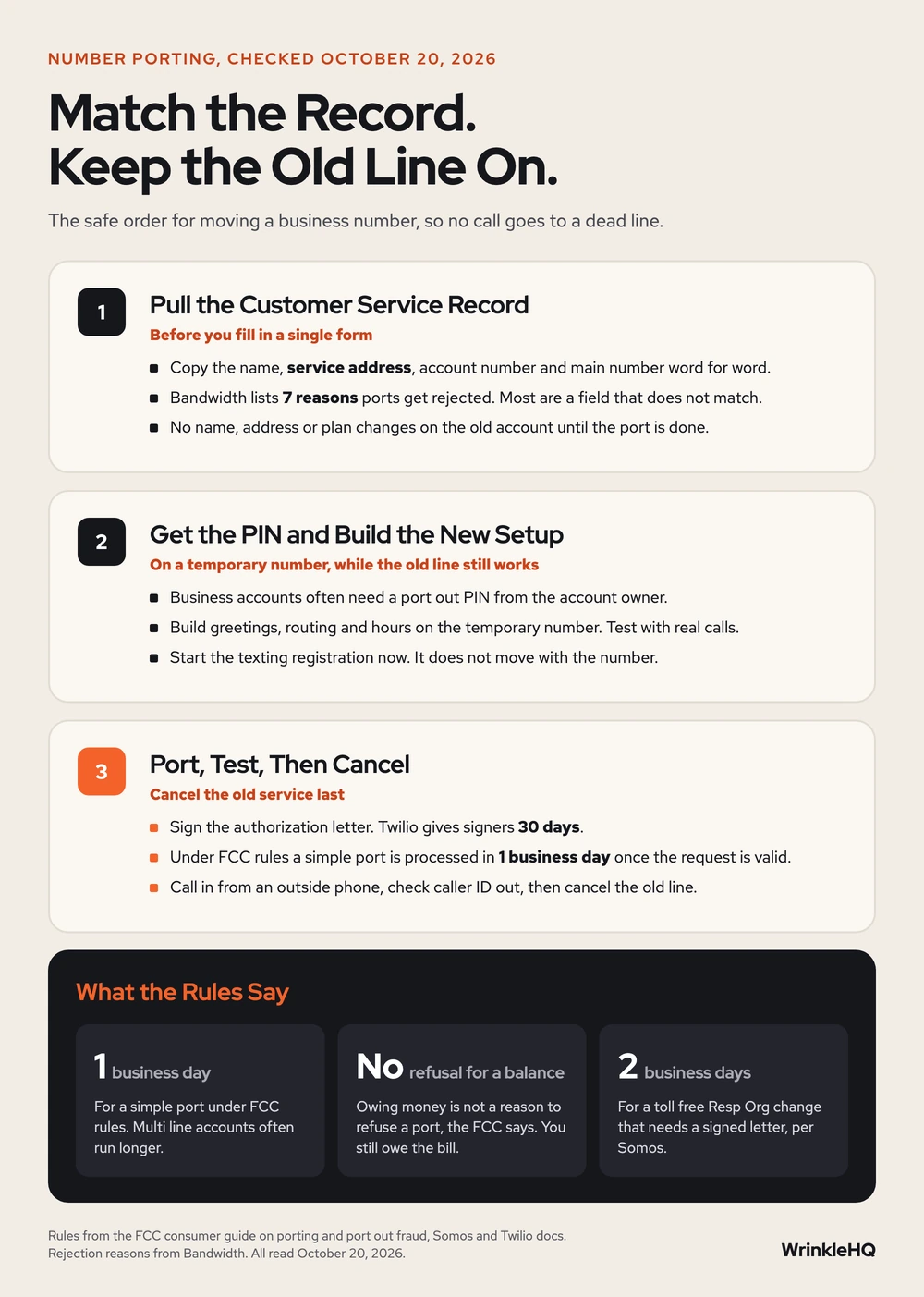
To port a business phone number, sign up with the new company first, give it the details exactly as your old carrier has them on file, and keep the old service on until the port is done. Most ports that fail never touch the phone network. They fail on a name, an address or a PIN that does not match.
- Year 1Website
- Year 2Map Listings
- Year 3Booking Tool
- Year 4Front Desk
- Year 5Payments
- Year 6Reports
Same six pieces.
Years of lessons, one read.
Free to read. Most of this guide is open. The finishing pieces at the end come to you when you opt in.
Start Here
- Never cancel the old service first. Cancel it and the number can be gone for good.
- Get your Customer Service Record and copy the name, service address and account number from it word for word.
- Business accounts often need a port out PIN that only the account owner can get.
- The FCC says a simple port must be done in one business day once a valid request is in. The paperwork before that is what takes the time.
- Calls move with the number. Texting registration, toll free routing and your call flows do not move on their own.
Why Ports Fail on Paperwork, Not on the Phone Network
We run the phone side for our own brands. Calls land in a CRM, texts get answered from one inbox, and tracking numbers sit in front of the main line. So we have moved numbers between carriers, VoIP apps and phone systems, and we have watched ports stall.
What we learned is simple. The number itself moves fine. The trouble is the request. The new company sends your details to the old one. If one field is off, the old carrier rejects it. Then the clock starts over.
Most guides on this topic are written by phone companies that want you to switch to them. They give you a five step list and a sign up button. They skip the parts that cost you a week. That is the record you have to match, the PIN on business accounts, and what does not move with the number. This guide covers those in the order we do them.
What the FCC Rules Actually Say
The FCC's own guide on keeping your number was last reviewed on December 10, 2025. We read it in October 2026. These are the lines that matter to a business.
| Question | What the FCC Says |
|---|---|
| Can I keep my number? | Yes, if you stay in the same area. It works between landline, internet phone and wireless companies. |
| Who starts the port? | The new company. You give it your 10 digit number and what else it asks for. |
| Should I cancel my old service? | No. Do not end the old service before the new one starts. |
| Can the old company say no because I owe money? | No. It cannot refuse to port, even with a balance or an early termination fee due. You still owe what your contract says. |
| Is there a fee? | Companies may charge one. The FCC says to ask if it can be waived. |
| How long does it take? | A simple port must be processed in one business day. Moves between wireless companies can take a few hours. Landline to wireless can take a few days. |
| When is porting not possible? | If you move to a new area, or if a rural carrier has a state waiver. |
That one business day line confuses people. The phone company that sold you the new plan may say five to ten business days. Both can be true. The FCC rule covers a simple port, which it describes as one line without complex changes to switching gear. A business with a main line, a fax line and a few extensions is often not simple. And the clock only runs once the old carrier accepts a clean request. Every rejection adds days before that clock even starts.
Step One, Pull Your Customer Service Record
Your old carrier keeps a Customer Service Record, called a CSR. It is the file the carrier checks your port request against. Your bill is not the same thing. A bill shows the billing address. The CSR shows the service address, and that is the one that has to match.
Ask your current carrier for a copy of the CSR, or at least read the fields off it with a rep on the phone. Some new providers pull it for you. Get it either way, because you will copy from it word for word.
Bandwidth, a carrier that handles ports for many phone apps, lists seven reasons port orders get rejected. Here they are, with what to copy from the CSR.
| Field | What Has to Match | Where It Goes Wrong |
|---|---|---|
| Business name | The exact name on the account | A missing LLC or Inc, or a trade name in place of the legal one |
| Service address | Where the line is installed | Someone uses the billing address or a PO box |
| Authorized name | The person the carrier has as the contact | An office manager signs, but the account is in the owner's name |
| Account number | The full number, as the carrier writes it | A number from an old bill, or a missing sub account |
| Billing telephone number | The main number on the account | Someone gives the number being ported, which is not always the main one |
| PIN or passcode | The PIN the carrier has on file | A wrong PIN, or none at all on an account that needs one |
| Pending orders | No open changes on the account | A feature change, address change or disconnect still in progress |
That last one bites people who try to clean up first. Do not change the name, the address or the plan on the old account in the weeks before a port. Make your cleanup changes after the number has moved.
Amazon's porting docs for its call center product list the same pattern in four buckets. An unpaid balance or port away fee, a name or address that does not match the CSR, a number that cannot be ported, and blank fields on the form. Its fix for a mismatch is the one we use. Either get the carrier to fix its record, or send a new request that matches the record as it stands.
Step Two, Get the Port Out PIN and Lock the Account
Many carriers now want a port out PIN, sometimes called a transfer PIN, before they release a number. It is a code the account holder gets from the old carrier and hands to the new one. On a business account, often only the main account holder can ask for it. If that person left the company or is hard to reach, sort that out before you start.
The PIN exists for a reason. The FCC warns about port out fraud. A scammer gathers your details, calls your carrier as you, and moves your number to a phone they control. Then they get the texts that reset your bank and email passwords. For a business, that can also mean your customers' calls go to a stranger.
So while you are in the account, do three things. Set a PIN or password if the account has none. Turn on alerts for account changes. And tell your team that nobody gives out account details to a caller who claims to be the phone company. The FCC says the first sign of this scam is usually a phone that goes dark or will only call 911.
If your carrier has a port lock or port protection setting, it will block your real port too. Turn it off right before you submit, and turn protection back on at the new company once the number lands.
Step Three, Keep the Old Line On and Pick the Port Date
Now sign up with the new company and set up the account. Do not cancel anything yet. The FCC is plain about this. End the old service first and there may be no number left to port.
- Get a temporary number from the new company and build your setup on it. Greetings, call routing, hours, voicemail and who rings when. Test it with real calls before the port.
- Fill in the port request from your CSR copy, not from memory. List every number you want to move, plus the ones you want to keep at the old carrier.
- Sign the Letter of Authorization. This form says you approve the move. Twilio's docs say its signer has 30 days to sign, or the request is cancelled.
- Watch for a confirmed date. Once the old carrier accepts, the new company gets a port date. Twilio's docs say a number in its Port Pending status moves on that date.
- Ask for a date that suits you. A slow weekday morning is best. Never the day before a holiday or a busy season.
- Cancel the old service only after the number rings on the new system and you have tested it.
On port day, calls can land on the old system for part of the day and the new one for the rest. Keep someone watching both. If your old service lets you forward calls, you can point the main number at the temporary number until the port lands.
What Moves With the Number and What Does Not
A port moves one thing. Calls to that number ring somewhere new. Everything you built around the number stays behind unless you rebuild it.
| Item | Does It Move? | What to Do |
|---|---|---|
| Inbound calls | Yes | Test from an outside phone after the port |
| Business texting | No, the registration does not move | Register again with the new provider before you text customers |
| Call flows and greetings | No | Build them on a temporary number first |
| Voicemail you have saved | No | Download what you need before you cancel |
| Toll free numbers | Moves by a different path | The new provider files a Resp Org change |
| Missed call textback | No | Reconnect it to the new system |
| 911 address | Check it | Confirm the address the new company has on file |
| Your listings | Nothing changes if the number stays the same | Leave them alone |
Texting is the one that catches businesses. If you text customers from your main number, that number has a texting registration tied to the old provider. Twilio's docs say to finish messaging and voice compliance before you use a ported number. Our A2P 10DLC registration guide walks through it. Start that the day you sign up, not the day the number lands.
Toll free numbers move another way. They are managed by a Responsible Organization, called a Resp Org. Somos, which runs the toll free registry, says the new Resp Org files the change in its system. When the old one needs a signed letter, requests must be handled within two business days. Twilio's port request tool, for one, does not take toll free numbers at all. Ask your new provider which path it uses.
Your listings are the quiet win. Keeping the same number means your Google Business Profile, your directories and the number painted on the truck all stay right. That is the reason to port and not just get a new number.
Look It Up Yourself
We opened each of these in October 2026 before writing this guide.
- Federal Communications Commission, Porting, Keeping Your Phone Number When You Change Providers, consumer guide last reviewed December 10, 2025.
- Federal Communications Commission, Port Out Fraud Targets Your Private Accounts, updated March 4, 2025.
- Bandwidth, 7 Most Common Reasons Your Port Order Is Rejected, Bandwidth blog.
- Amazon Web Services, Documentation Requirements for Porting Numbers, Amazon Connect admin guide.
- Twilio, Port In Phone Numbers, Twilio docs.
- Somos, Utilizing the ROC System for Toll Free Number Port Changes, December 5, 2019.
What the Finishing Pieces Contain
With the steps above you can port a number and keep the phones ringing. The finishing pieces give you the request sheet we fill in before every port, the rejection reasons with the fix for each one, and the check we run on port day. A phone number is one part of how a business answers. See how we set up answering for a small business, and how a missed call textback catches the calls nobody picks up.
The finishing pieces
Get the Rest of This Guide
You have the method. The finishing pieces are the parts you copy straight into your own work:
- The Port Request Sheet We Fill In Before Every Port
- Rejection Reasons and the Fix for Each
- The Check We Run on Port Day
Odds and Ends
- How long does it take to port a business phone number?
- FCC rules say a simple port must be processed in one business day once a valid request is accepted. Business accounts with several lines often take longer, and each rejection adds days before that clock starts. Plan on a week or two and keep the old line on the whole time.
- Can my old carrier refuse to port my number if I owe them money?
- No. The FCC says your old company cannot refuse to port your number, even if you owe a balance or an early termination fee. You still owe that money under your contract.
- Should I cancel my old phone service before I port my number?
- No. The FCC says not to end your old service before the new one starts. Cancel only after the number rings on the new system and you have tested it.
- Can I port a toll free number?
- Yes, but it moves by a different path. Toll free numbers are managed by a Resp Org, and the new one files the change through the toll free registry run by Somos. Ask your new provider if it handles toll free ports.
- Will my business texting work after I port my number?
- Not until you register it with the new provider. The number moves, but the texting registration does not. Start that registration the day you sign up so it is ready when the number lands.
Other Answers
 Avenue 2 of 8
Answering Every Call, Even the Ones You Miss
When you cannot pick up, the customer gets a text back in seconds and a way to tell you what they need. When the question needs a person, it goes to a person.
Read it Free guideTexting Guide
A2P 10DLC Registration for a Small Business
If your business sends texts from a normal ten digit number through any software, you have to register for A2P 10DLC or the carriers filter you and charge extra. Register the brand, then the campaign, and make your website, samples and opt-in box match before you file, because a mismatch is what gets you rejected.
Read it Free guideAnswering Guide
Build a Missed Call Textback That Does Not Embarrass the Business
A missed call textback should know who called before it picks its words, and it should never say something the business would not say. This guide shows you how to build one that holds up when nobody is watching.
Read itWe sell time
Get Years of Building Switched On in Hours
A thirty minute call. A written price. Nothing built until you say yes.